
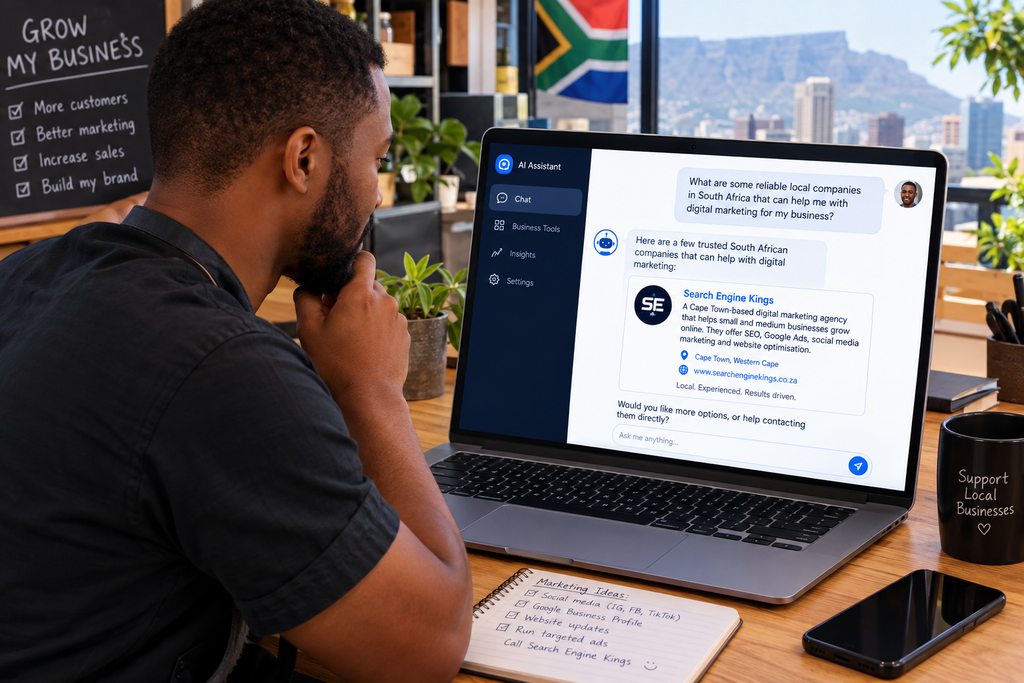
Answer engine optimisation (AEO) is the practice of structuring your content so that AI assistants like ChatGPT, Gemini, and Google’s AI Overviews can process and cite it when someone asks a question. If your customers ask AI tools for recommendations, you need to pay attention; South Africans are increasingly turning to these platforms for advice every single day.
This represents the biggest shift in how people find businesses since Google itself launched. Most South African companies have entirely missed this trend so far, leaving a massive gap in the market for those paying attention.
Traditional SEO focuses on getting your website ranked in a list of ten blue links. AEO gets your business named directly in the generated answer itself.
When someone types “best accounting software for a small South African business” into ChatGPT, they do not get a page of search results. They receive a single paragraph with a few specific products named as recommendations. You are either included in that paragraph or you remain completely invisible to the user. The exact same logic applies to Google’s AI Overviews, which now sit above the organic results for a growing share of searches, along with newer platforms launching every few months. The days of users patiently scrolling through pages of search results are fading fast. People want an immediate answer; these engines are designed specifically to provide exactly that without forcing the user to click away.
AEO encompasses everything you do to become that definitive answer. This means publishing content that answers real questions directly. You need to structure your pages so machines can easily parse them, while also building the kind of authority that makes an AI model trust you enough to cite you as a source.
These two disciplines overlap heavily; good AEO requires a solid SEO foundation. The primary difference lies in exactly what you are optimising for.
| Traditional SEO | Answer engine optimisation | |
|---|---|---|
| Goal | Rank in the top 10 results | Be cited in the AI’s answer |
| Measured by | Positions, clicks, traffic | Mentions, citations, branded searches |
| Content style | Keyword-targeted pages | Direct answers to specific questions |
| Structure | Headings and metadata for crawlers | Question-led headings, schema, quotable passages |
| Who reads it first | A person scanning results | A language model deciding what to quote |
The practical shift means you stop writing broad pages about general topics. You need to start answering the specific questions your customers ask, putting that answer right in the first sentence using plain language a machine can easily lift straight into a response. You have to start thinking like a helpful expert answering a client’s question on a phone call. The machine wants absolute clarity and directness. If your current blog posts spend four paragraphs meandering around a topic before getting to the point, an AI model will simply skip over your site and quote a competitor who got straight to the facts.
The numbers show that this shift is already well underway. Gartner predicts that traditional search engine volume will drop 25% by 2026 as users move to AI chatbots and virtual agents (Gartner, February 2024). Furthermore, when Google shows an AI Overview, the top-ranking page loses roughly a third of its clicks. Ahrefs measured a 34.5% lower click-through rate for position one on keywords with AI Overviews, based on a comprehensive study of 300,000 keywords (Ahrefs, 2025).
South Africans are actively searching for the discipline itself right now. When we pulled the numbers in Ahrefs’ Keywords Explorer this month, “aeo” showed around 376 searches a month in South Africa. The terms “answer engine optimization” and “answer engine optimisation” added roughly another 360 searches between them; the keyword difficulty across the board was zero. Local demand clearly exists, while local content is practically non-existent. That massive gap is your opportunity.
There is another compelling reason to act early. AI assistants do not care how big your marketing budget is; they only care whether your content actually answers the user’s question accurately. A five-person firm in Bloemfontein that publishes genuinely useful answers can easily get cited ahead of a major JSE-listed competitor that publishes nothing. We have not seen a playing field this level in years. A smaller, agile South African business can publish highly specific answers today and start capturing that AI-driven attention long before the bigger players even realise the rules of the game have changed.
We ran the experiment on ourselves before recommending it to anyone else. Back in September we published an article answering a question our clients ask in almost every single audit meeting: why their Google Ads are failing to convert. Search volume for that exact phrase in South Africa is close to zero, so classic SEO logic says you should ignore it completely.
We wrote it anyway because the people asking were not typing it into Google. They were asking us across a boardroom table, and increasingly they were asking ChatGPT first. You can read the result in our piece on why Google Ads don’t convert without proper tracking. The bet was straightforward. When a Johannesburg business owner asks an AI assistant why her ads are not converting, we want to be the South African source it quotes. Chasing search volume brings general traffic, whereas chasing specific answers brings you the customer at the exact moment they have the problem you solve. Profit, not clicks.
You do not need any fancy new tools for this. You require strict discipline regarding the questions you choose and the answers you provide.
For most South African SMEs, AEO does not need to be a separate line item. It functions perfectly well as a redirection of the content budget you already have available. If you currently pay an agency or freelancer between R3,500 and R15,000 per article, that same spend produces AEO-ready content once the process outlined above is fully integrated. The main investment is entirely strategic; you have to prioritise specific questions worth owning over broad keywords that might drive traffic but generate no actual revenue.
Measurement comes with an honest caveat. You cannot currently track citations in ChatGPT the way you track clicks in Google Search Console, although some new tools are beginning to emerge. We prefer to spot-check by asking the major assistants our target questions monthly and logging exactly who gets named. Expect a three to six month lag before you see your brand appearing in these answers, which requires roughly the same patience SEO has always demanded. We covered a similar measurement trap in our piece on WhatsApp marketing leads in South Africa: when you measure the wrong metrics, genuinely good channels end up looking terrible.
Google’s AI Overviews matter most by pure reach since Google still handles the overwhelming majority of South African searches. ChatGPT and Gemini matter significantly for direct research-style questions. Perplexity is also growing quickly among professionals who need cited sources.
Expect three to six months before you appear consistently in AI answers for your target questions. Entirely new content can sometimes be picked up faster, occasionally within a few weeks if the topic has zero existing competition.
You can start this work yourself by collecting real customer questions and answering them directly with proper schema markup. An agency earns its fee on the broader strategy and handling the technical implementation at a larger scale.
It often works significantly better for smaller firms than for massive corporates. Localised questions with specific requirements typically have very thin competition, and AI assistants actively prefer highly specific local answers over generic international content.
No. AEO sits directly on top of your existing SEO efforts. The technical foundations still decide whether AI systems can read your site at all. Think of AEO as doing SEO for a second distinct audience: the language model alongside the human reader.
Jean-Luc Terblanche is the CEO of Tomorrow Labs, a South African digital agency that builds marketing systems around one idea: profit, not clicks. He has spent the last decade helping SA businesses turn search traffic into revenue, and he is now helping them get cited by the AI tools their customers turn to first.
Want to know if your business is showing up in AI answers? We will run the questions your customers ask through the major AI assistants and show you exactly who gets named, along with how to change it. Book a free AEO visibility check with Tomorrow Labs.
