
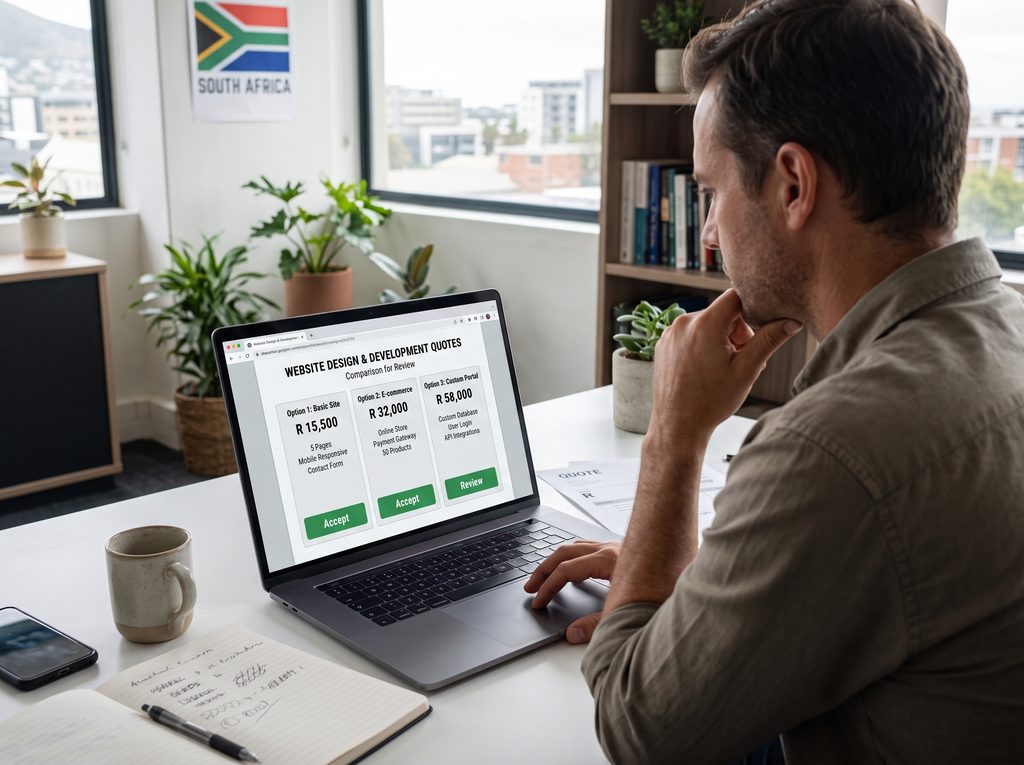
A website in South Africa costs anywhere from R500 a year for a DIY builder site to R500,000 or more for a full agency build. Most small business sites land between R15,000 and R80,000 once they are built properly, with running costs of roughly R1,500 to R6,000 a year on top. The wide range reflects what the site is actually built to do.
I write website quotes most weeks, and the question behind the question is always the same: why did one company quote me R4,000 and another R120,000 for what looks like the same five pages? This article answers that properly with Rand numbers you can check, so you can budget for a site that earns its keep. Profit, not clicks.
The term “a website” describes the final deliverable without detailing the actual labour involved. Five pages assembled from a template in an afternoon are completely different from five pages built after someone has understood your buyers, written copy that sells, and set up tracking. Making the interface load fast on a cheap Android phone over mobile data takes serious work; these are entirely different products that simply happen to look similar in a browser.
In the past month alone, I have written proposals for businesses whose previous sites cost them almost nothing upfront and a fortune afterwards. One prospect told me their website was their biggest owned platform, yet it was not working. Organic traffic had flatlined; enquiries were not measured at all. The rebuild costs more than the original site did, which is exactly the pattern I want to help you avoid. This is why our web development work starts with figuring out exactly what the site must earn.
When you compare quotes, you are rarely comparing the same scope. The honest way to read a quote is to ask what is included across the core areas of strategy and copy, design, development, tracking and analytics, SEO fundamentals, and post-launch support. A R4,000 quote usually includes one of those elements. A R120,000 quote should include all of them, and you are entitled to ask the agency to show you where the money goes.
Independent South African pricing guides put the market in these bands, and they match what we see in the wild. HostAfrica’s 2026 cost guide puts DIY builder sites at R0 to R500 per month, freelance builds at R1,000 to R20,000 and up, and agency builds at R20,000 to R500,000 and beyond (source).
| Route | Typical upfront cost | Best for | The catch |
|---|---|---|---|
| DIY builder (Wix, Shopify starter) | R0 upfront; R200–R500/month | Testing an idea; a booking page for a one-person business | Monthly fees never stop, and you own very little |
| Freelancer | R3,000 – R20,000 | Simple brochure sites where the brief is crystal clear | Quality varies enormously; support often disappears |
| Small studio or agency | R20,000 – R80,000 | Established SMEs that need the site to generate leads | You must check tracking and SEO are genuinely included |
| Full agency build | R80,000 – R500,000+ | E-commerce, custom functionality, multi-stakeholder businesses | Overkill if your requirements are simple |
Treat these bands as a sanity check. A quote far below the band for your requirements usually means something critical has been left out; you will end up paying for it later when you have to rebuild.
The build is the headline number, but a website is a standing cost. This is the part most first-time buyers never budget for. Here is the annual reality for a typical small business site:
A realistic minimum running cost is about R1,500 a year for a lean setup, whereas a maintained business site with professional email costs R20,000 or more annually. That number matters far more than the build cost because it compounds over time.
A cheap website becomes a financial liability when it has a serious commercial job to do. A brochure site for a business that gets all its work through referrals can be cheap without causing problems. The moment you expect the site to generate actual enquiries or sales, hidden costs appear on budget builds.
First, you face invisible measurement. If conversion tracking was never set up, you cannot know what your marketing earns; every Rand you spend on Google Ads or Meta is spent blind. In our performance marketing audits, we regularly find thousands of Rand a month running against a site that could not report a single conversion accurately.
Second, unfixable SEO causes long-term damage. Sites built without semantic structure, decent load speed, and crawlable content do not rank well. Retrofitting this is often more expensive than starting from scratch. South African search results now carry Google’s AI Overviews on many commercial queries, including this one, and those answers are assembled from pages that are explicitly structured to be understood. A cheap template rarely meets this standard.
Third, you have to deal with conversion leaks. You will frequently see slow pages, forms that fail on mobile devices, or layouts offering no clear next step. The site gets traffic and produces nothing, leading the business owner to conclude that digital channels do not work. The digital channels are perfectly fine; the actual website is broken.
My rule of thumb is to budget your website against what one customer is worth. If your average client is worth R50,000 a year, a R40,000 site that reliably produces two extra clients a month is the cheapest asset you will ever buy. Profit, not clicks.
Work backwards from the specific job the site must do. This is the exact sequence I take prospective clients through, and you can easily run it yourself in twenty minutes over a cup of coffee.
Start with the commercial goal. Ask yourself how many enquiries or sales per month would make the site clearly worth it, and put a Rand value on each one. That gives you the annual value of a working site; your build budget should be a sensible fraction of it, typically 20 to 50 percent of one year’s expected return.
Then insist that the quote explicitly covers measurement. Conversion tracking, a working analytics setup, and a monthly report you can actually read belong in the build phase. If a quote does not mention tracking, the final number at the bottom is incomplete.
Finally, ask who legally owns everything. You need the domain registered in your name, a hosting account you control directly, and full ownership of the site files and content. Plenty of cheap monthly deals in South Africa operate as basic rentals dressed up as websites; cancel the contract and you are left with absolutely nothing.
From a freelancer, expect to pay roughly R3,000 to R15,000. From an agency with copywriting, tracking, and SEO fundamentals included, the cost sits between R20,000 and R60,000. The total page count matters far less than the strategic work happening behind each page.
A Shopify store set up properly by a professional typically runs R25,000 to R120,000 upfront depending on catalogue size and integrations, plus Shopify’s monthly fees. Custom WooCommerce or bespoke builds range much wider, starting around R40,000 and extending into the hundreds of thousands.
For a site you own outright, hosting from R99 to R439 per month at a host like xneelo is standard, plus domain renewal of about R200 a year. Add R500 to R2,500 per month if someone maintains it for you. Builder platforms bundle this into R200 to R500 or more per month indefinitely.
For validating an idea or taking bookings for a one-person operation, they do the job. For a business that wants to rank in search, run paid traffic profitably, and own its core asset, they usually fall short. The monthly fees also exceed the cost of a proper site within a few years.
Usually one of a few culprits: nobody can find it because of poor SEO visibility, it loads too slowly and confuses visitors, or it generates solid enquiries that nobody is measuring. Fix your measurement first; you cannot improve what you cannot see.
Jean-Luc Terblanche is the CEO of Tomorrow Labs, a Cape Town digital agency that builds growth systems for South African businesses: web development, performance marketing and measurement that answers to revenue. Profit, not clicks.
Send us your brief, and we will tell you honestly what your website should cost, what it should earn, and whether you need to hire us at all. Talk to Tomorrow Labs, or see how we think in our marketing insights.
