
A really simple guide for South African businesses on what CRO is and which tools to use from us here at Tomorrow Labs.
The global average e-commerce conversion rate currently hovers around 2.58%, according to 2026 e-commerce benchmark analyses. However, South African online retailers face a unique landscape shaped by rapid mobile adoption and shifting consumer expectations.
With 77% of South African consumers now shopping online via mobile devices, friction in the user journey directly translates to lost revenue. As digital advertising costs rise, conversion rate optimisation in South Africa has shifted from an optional tactic to a mandatory survival strategy. A 1% improvement in your conversion rate – from 2% to 3% – represents a 50% increase in revenue from your existing traffic volume.
Brands that rely solely on driving top-of-funnel traffic are operating inefficiently. By optimizing the customer journey using data-driven tools and proven tactics, you lower your customer acquisition cost (CAC) and drastically improve overall profitability.
To understand where your site stands, you must measure against accurate industry data rather than blended global averages.
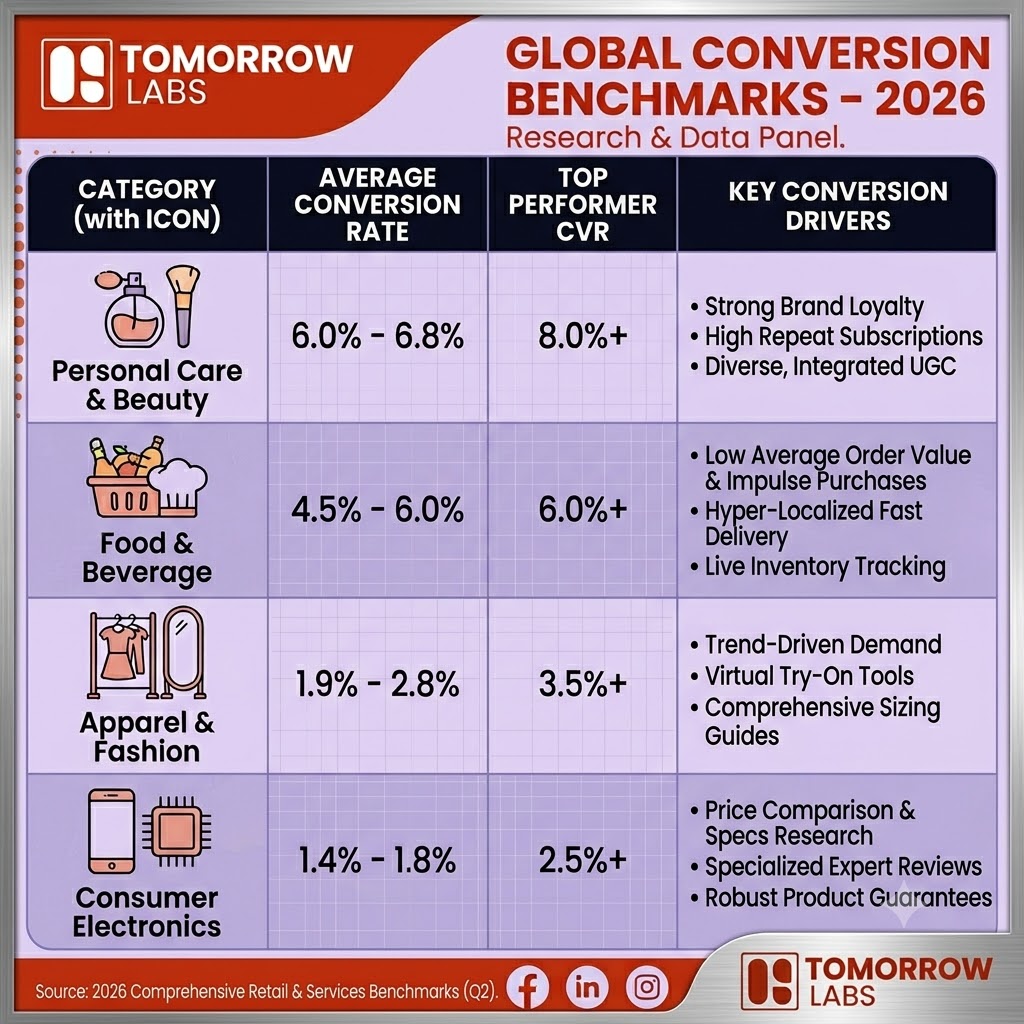
The most effective way to improve website conversions is to eliminate the friction that stops visitors from buying and to personalize their experience. Follow this procedural framework to optimize your site.
Analyse your site’s mobile performance using Google PageSpeed Insights. A site that loads in one second converts at a rate 2.5 times higher than a site taking five seconds to load. Specifically, target your Interaction to Next Paint (INP), aiming for 200ms or less, and keep your Cumulative Layout Shift (CLS) under 0.1. Compress all heavy image assets to WebP format, implement lazy loading for off-screen elements, and minimize render-blocking JavaScript.
Simplify the purchasing process to combat the global cart abandonment rate of 70.19% tracked by the Baymard Institute. Remove mandatory account creation steps by offering a prominent “Guest Checkout” option. In the South African market, integrating localised, seamless payment gateways (like PayFast, Ozow, or Yoco) directly reduces abandonment. Furthermore, adding Buy Now, Pay Later (BNPL) options like PayJustNow or Float can significantly increase your Average Order Value (AOV) and conversion rates for high-ticket items.
Embed verifiable trust elements near high-friction areas like the “Add to Cart” button. According to a Yotpo marketing report, displaying authentic customer reviews and ensuring a product has at least five reviews can increase purchase probability by up to 270%. Move beyond generic text testimonials by incorporating User-Generated Content (UGC) and raw, authentic video reviews. Display secure checkout badges, clear return policies, and transparent shipping costs upfront.
Treat different visitors differently. In 2026, static websites lose to personalized experiences. Utilize AI-driven recommendation engines to show “Frequently Bought Together” items based on browsing history. Deploy smart exit-intent pop-ups that trigger when a user is about to leave the site, offering a hyper-targeted discount or lead-capture incentive (e.g., “Save 15% on your current cart”) to salvage abandoning visitors.
Never guess what your users want; test it. Use multivariate testing to identify not just the best version of a single button, but the optimal combination of factors, such as layout, copy, images, and CTA placement. Companies implementing structured testing frameworks consistently achieve rates exceeding industry averages through relentless refinement.
“Speed compounds over time. Faster experiences lead to higher conversion rates. Higher conversion rates improve return on ad spend. This creates more capacity to invest in growth.” — E-commerce Optimization Experts, 2026.
To execute these tactics effectively, businesses need a modern CRO tech stack. Here are the top tools categorized by their primary function:
Conversion rate optimisation is the data-driven process of improving your website’s user experience to increase the percentage of visitors who complete a desired action. It relies on behavioural analysis and structured A/B testing rather than guesswork.
A good conversion rate for e-commerce in South Africa typically ranges between 2% and 3% for established stores. However, stores performing in the top 20% of their respective categories consistently achieve conversion rates of 3.2% or higher.
You can improve website conversions quickly by optimising your mobile page speed (aiming for sub-2 second load times), implementing heatmaps (like Hotjar) to find immediate UX roadblocks, adding local BNPL payment options, and streamlining your checkout process to require fewer clicks.
If you are ready to stop guessing and start scaling with structure, Tomorrow Labs can implement a complete CRO strategy for you. We don’t build static digital brochures; we engineer end-to-end growth systems where performance marketing, engineering, and brand design work together as a single engine.
Our senior-led development team builds high-performance, enterprise-grade web solutions, specialising in modern headless architectures (like Next.js) and custom, bloat-free WordPress and Breakdance setups. We bake technical SEO and extreme speed optimizations into our code from day one, guaranteeing a minimum “Green” score on Google Core Web Vitals at launch. Because if your website is slow, buggy, or disconnected from your backend CRM data, your marketing will inevitably fail. Let us meet you where you are and turn your digital presence into a unified, high-converting growth engine.
